On this page · 10 sections
- 01How much does a PCB cost in India?
- 02Why does board size matter more than you think?
- 03How does layer count change the price?
- 04Why is the price per board lower at higher quantities?
- 05Which material, copper and finish choices affect cost?
- 06Do tight tolerances and special features cost extra?
- 07How much does faster delivery add?
- 08What else goes into the final price in India?
- 09How can you reduce the cost of your PCB?
- 10How do you get an exact price for your board?
Building this board?
A bare board has no list price. Its price is built up from the specification: how much laminate it uses, how many process stages it passes through, how many boards share the set-up and how fast you need them. This guide explains each factor, shows which ones move the price most, and lists the choices that cut cost without cutting quality.
How much does a PCB cost in India?
A PCB costs what its specification costs to build. The same 100 × 68 mm double-sided board costs many times more per piece as one urgent prototype than as one of a thousand boards on standard dispatch. Three factors set most of the price: board area, layer count and quantity. Material, copper, finish, tolerances, testing and lead time adjust it from there. For rigid one- and two-layer boards, an instant quote shows the exact price for your size, quantity and options in seconds.
Every order carries two kinds of cost. Set-up cost is paid once per order or revision: CAM engineering, the imaging and drill programs, the electrical-test program and handling. Run cost is paid per production panel: laminate, copper, chemistry and machine time at every stage. On a prototype the set-up dominates; on a production run the panel cost does. That one idea explains most of what follows.
Table 1 · What sets the price of a bare PCB
| Factor | Lowest-cost choice | What raises the price | Effect |
|---|---|---|---|
| Board area and panel fit | A compact rectangle that nests well | Large or irregular boards that waste panel area | Large |
| Layer count | One or two layers | Inner layers, lamination and X-ray drilling — each layer pair adds stages | Large |
| Quantity | Enough boards to share the set-up | One-off orders carry the whole set-up cost | Large per board |
| Base material | FR-4 Tg 150 °C; FR-2 or CEM-1 for single-sided | High-Tg FR-4, polyimide flex | Moderate |
| Thickness and copper | 1.6 mm, 1 oz (35 µm) | Very thin or thick boards, 2 oz and heavier copper | Moderate |
| Track, space and drill | 6 mil / 6 mil, 0.3 mm drills, a modest hole count | 4 / 4 mil, 0.2 mm drills, thousands of holes | Moderate |
| Surface finish | HASL, lead-free HASL or OSP | ENIG (nickel and gold) | Small to moderate |
| Tolerances and features | Standard limits | Controlled impedance, tight outline tolerance, castellations, IPC Class 3 | Moderate to large |
| Lead time | Standard dispatch | Short dispatch options and 24-hour express | Moderate to large |
Relative effect of each factor with everything else held constant. The real figure depends on the full specification and quantity. Scroll the table sideways →
Why does board size matter more than you think?
Boards are not made one at a time. They are built on production panels, and the price follows the panel area each board consumes — including the spacing between boards, the routing gaps and the rails with tooling holes that carry the panel through every machine. A board that fills the panel neatly costs less per square centimetre than one that leaves offcuts.
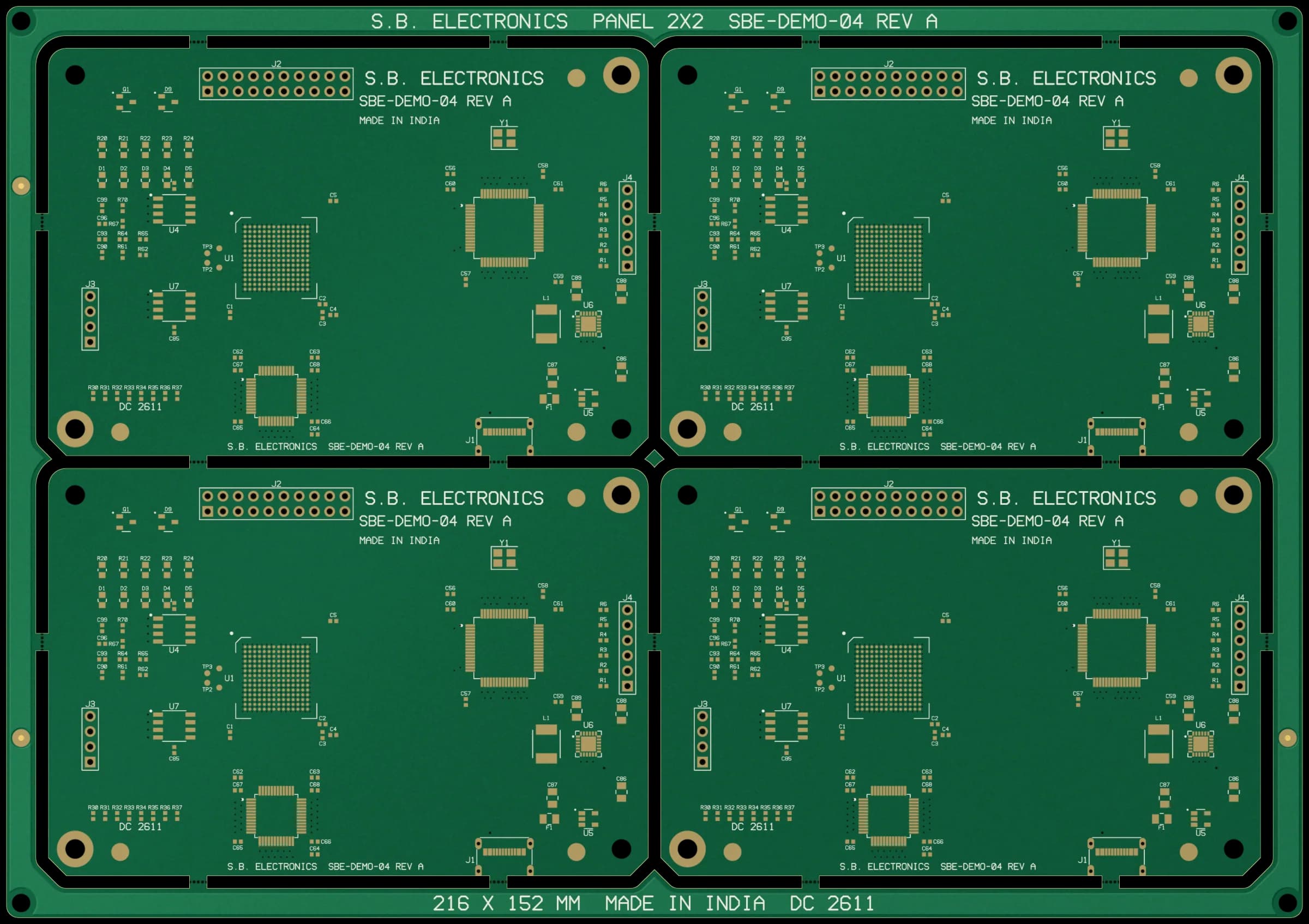
The panel in Fig. 01, at the top of this page, shows the arithmetic. Four 100 × 68 mm boards sit in a 216 × 152 mm panel: 27,200 mm² of product in 32,832 mm² of laminate, so about 83% of the area becomes boards and the rest is rails and routing gaps. Trim a few millimetres from an outline that only just misses a better fit and the boards per panel can jump; add a large cut-out and you pay for laminate that is routed away.
A100 × 68 mm board · 4 per panel
83% of the laminate becomes boards; the rest is rails, routing slots.
B106 × 68 mm board · 2 per panel
44% of the laminate becomes boards; the rest is rails, routing slots and offcut.
To scale · 5 mm rails with tooling holes and fiducials · 2 mm routing slots
- Keep outlines rectangular where the enclosure allows. Irregular shapes nest poorly and need more routing time.
- Ask how the board nests before you freeze its size. A small change to one dimension can fit an extra row of boards on every panel.
- Let CAM panelise unless your assembly line needs a specific panel.
How does layer count change the price?
Each step up in layer count adds whole process stages, not just copper. A single-sided board is printed and etched, and its holes are drilled but never plated. A double-sided PTH board adds hole metallisation and copper plating so the two sides connect. A multilayer board adds inner-layer imaging, etching and inspection, an oxide treatment and a lamination press cycle before it is even drilled. That is why the step from two to four layers is the largest single jump in most quotes.
Table 2 · What each construction adds
| Construction | Extra work over the row above | Typical use |
|---|---|---|
| Single-sided | None — print, etch, drill, mask, finish | Power supplies, LED drivers, appliance controls |
| Double-sided NON-PTH | A second copper image, registered to the first | Simple two-sided consumer boards |
| Double-sided PTH | Hole metallisation and copper plating | Most industrial, instrument and control boards |
| 4 layers | Two inner layers: imaging, etch, AOI, oxide, lamination, X-ray-aligned drilling | Microcontroller boards with a ground plane, USB, Ethernet |
| 6 to 12 layers | More cores and prepreg, tighter registration, longer press cycles | Dense BGAs, many power rails, controlled impedance |
We build 1 to 12 layers in-house. Compare total cost, not cost per square centimetre: a four-layer board is often smaller than the two-layer version of the same circuit. Weigh the single-sided, double-sided and multilayer options on that basis.
Why is the price per board lower at higher quantities?
Because the set-up is shared. CAM review, programs and test set-up cost about the same for five boards as for five thousand. On a prototype that fixed cost lands on a handful of boards; on a production order it almost disappears, and laminate and process time take over.
Table 3 · Where the money goes as quantity grows
| Order size | What dominates the price | How to spend less |
|---|---|---|
| Prototype (1–10 boards) | Set-up: CAM, programs, test set-up, handling | Add spares to the same lot; a second small order pays most of the set-up again |
| Pilot batch (tens to hundreds) | Set-up and panel cost, roughly in balance | Freeze the design first, so the batch is built from the production revision |
| Production (thousands) | Laminate, copper, chemistry and machine time per panel | Optimise panel fit, standard materials and the test method |
Testing follows the same pattern. Every board we ship gets a 100% electrical test — flying probe or bed-of-nails fixture — plus AOI. A flying probe needs no fixture, which suits prototypes; a bed-of-nails fixture costs money to build but pays back at volume. There is no minimum order quantity — one prototype board upwards.
Which material, copper and finish choices affect cost?
Standard choices cost least because they run every day: FR-4, 1.6 mm, 1 oz copper, green mask, white legend and HASL. Each change moves the price — sometimes very little.
- Laminate. FR-2 and CEM-1 are the lowest-cost single-sided materials; FR-4 is the default for double-sided and multilayer. High-Tg FR-4 costs a little more and earns it on lead-free reflow and hot service. Polyimide flex costs considerably more.
- Copper weight. We run 1 oz (35 µm) and 2 oz (70 µm) standard; 3 oz (105 µm) and heavier on request. Heavier copper takes longer to plate and etch and needs wider spacing, so it costs more and rules out the finest lines.
- Surface finish. HASL and OSP are the least expensive; ENIG costs more because it deposits nickel and gold in a longer chemical sequence. On a board with a fine-pitch BGA, ENIG usually saves more in assembly yield than it costs — see surface finishes compared.
- Thickness. We build 0.4 mm to 3.2 mm standard; 0.2 mm for thin rigid designs. Thin boards need careful handling and thick boards drill more slowly, so both ends of the range can cost more than 1.6 mm.
Do tight tolerances and special features cost extra?
Yes, because each one adds a process step, slows a step down or lowers the number of good boards per panel. None of them is wrong to specify, but each should earn its place on the drawing.
- Fine lines and small holes. Designing to 4 / 4 mil track and space or 0.2 mm drills instead of 6 mil / 6 mil and 0.3 mm narrows the process window. Use them where the parts demand it, not across the whole board.
- Controlled impedance. We offer controlled impedance, ±10% tolerance, with stack-up design support. It needs a calculated stack-up, test coupons on every panel and a TDR measurement — engineering time well spent on fast interfaces, and wasted on a board without them.
- Outline tolerance. Ours is ±0.15 mm as standard; ±0.1 mm on request. Ask for the tighter figure only where an enclosure or connector needs it.
- IPC Class 3. Thicker hole-wall copper, no annular-ring breakout and microsection evidence for every lot raise the cost of the same artwork. IPC Class 2 vs Class 3 explains where the money goes.
How much does faster delivery add?
Speed is priced because it reorders the factory: a board that jumps the queue displaces others and often runs in a smaller batch. For rigid one- and two-layer boards, the instant quote offers dispatch in 3, 5, 7 or 10 working days and prices each option live, so you see what a faster date costs before you order. Urgent simple prototypes can be turned round in 24 h by arrangement; multilayer lead times are quoted per job after engineering review.
The cheapest speed-up is free: send complete data. A job held for an engineering query loses days that no express charge buys back. Our guide to PCB lead time shows where the days go.
What else goes into the final price in India?
The board price is not the whole invoice. GST applies to printed circuit boards at the rate in force, and courier charges depend on weight and destination. Buying from abroad adds freight, customs duty, clearance charges and currency conversion, and IGST is paid at the border before any input credit comes back — costs an overseas unit price leaves out. Local manufacture also shortens every revision loop.
Assembly is priced separately from the bare board. Its cost is driven by the bill of materials (usually the largest item), the number of placements and joints, the mix of SMT and through-hole parts, the stencil, set-up per side and the inspection plan — AOI, X-ray for BGAs and any functional test. See PCB assembly and component sourcing for what we need to quote it.
How can you reduce the cost of your PCB?
- Design to standard capabilities. Use the standard track, space and drill sizes on our capabilities page wherever the parts allow, and keep fine-line rules for the areas that need them.
- Start from the standard build. FR-4, 1.6 mm, 1 oz copper, green mask, white legend and HASL or lead-free HASL — then change only what the product needs.
- Choose the layer count on total cost. Fewer layers cost less per square centimetre, but a smaller four-layer board can beat a larger two-layer one.
- Make the outline panel-friendly. Rectangular, without needless cut-outs, and sized after asking how it nests.
- Order the right quantity. Add spares to a prototype lot rather than placing a second order, and combine pilot and first production where the design is stable.
- Pick the finish on pitch, not habit. ENIG where fine pitch, BGAs or long storage demand it; HASL or OSP elsewhere.
- Pay for speed only on the critical path. Choose the latest dispatch date your schedule allows.
- Send a complete data pack. Gerbers, drill, outline and a fab note avoid queries, re-quotes and delays — see how to prepare Gerber files.
How do you get an exact price for your board?
For rigid single- and double-sided boards, use the instant quote: enter the size (10 mm to 600 mm per side), the quantity (1 to 100,000 boards per line), your options and a dispatch date, and the price updates as you choose. Multilayer, flex, impedance-controlled, assembly, stencils, component sourcing and large-volume work are quoted by an engineer: send the data pack through our contact page and we aim to reply within 24 hours on working days.
Written by
S.B. Electronics Engineering Team
The CAM, production and quality engineers at our factory in the Gandhinagar G.I.D.C. Electronics Estate — the people who review incoming data and build the boards. Published .